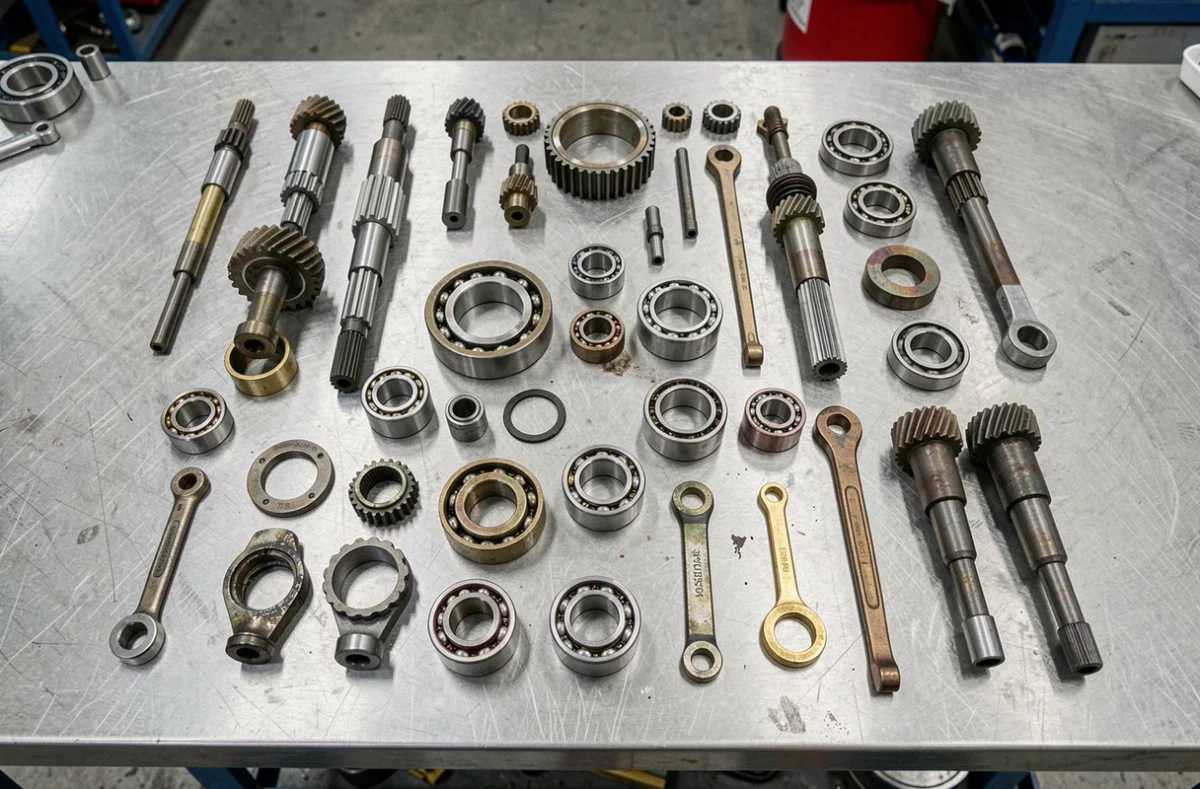
When you hear a crack when shifting into third gear or when a gear slips while climbing, the first question from the mechanic concerns the internal parts of the gearbox. Understanding the composition of an automotive gearbox allows for a quicker diagnosis and facilitates discussions with a mechanic without navigating blindly. The components vary depending on the type of transmission, but a common mechanical base can be found in the vast majority of vehicles.
Mechatronic unit and hydraulic control in dual-clutch transmissions
In a dual-clutch transmission, the mechatronic unit combines the electronic control and the hydraulic components that manage gear shifts. This module controls the oil pressure sent to the clutches, decides which gear to engage, and at what speed to do so. In the workshop, a fault code related to the gearbox may point to this unit rather than a worn gear.
The mechatronic unit is a fully functional assembly. It combines speed sensors, solenoids, and a control unit in a compact housing mounted directly on the gearbox casing. A fault diagnosis concerns both the control and the mechanical parts. Replacing a clutch without checking the condition of the mechatronic unit is akin to changing brake pads without inspecting the caliper.
To better understand the composition of an automotive gearbox, it is useful to distinguish each component and its role in the transmission chain.
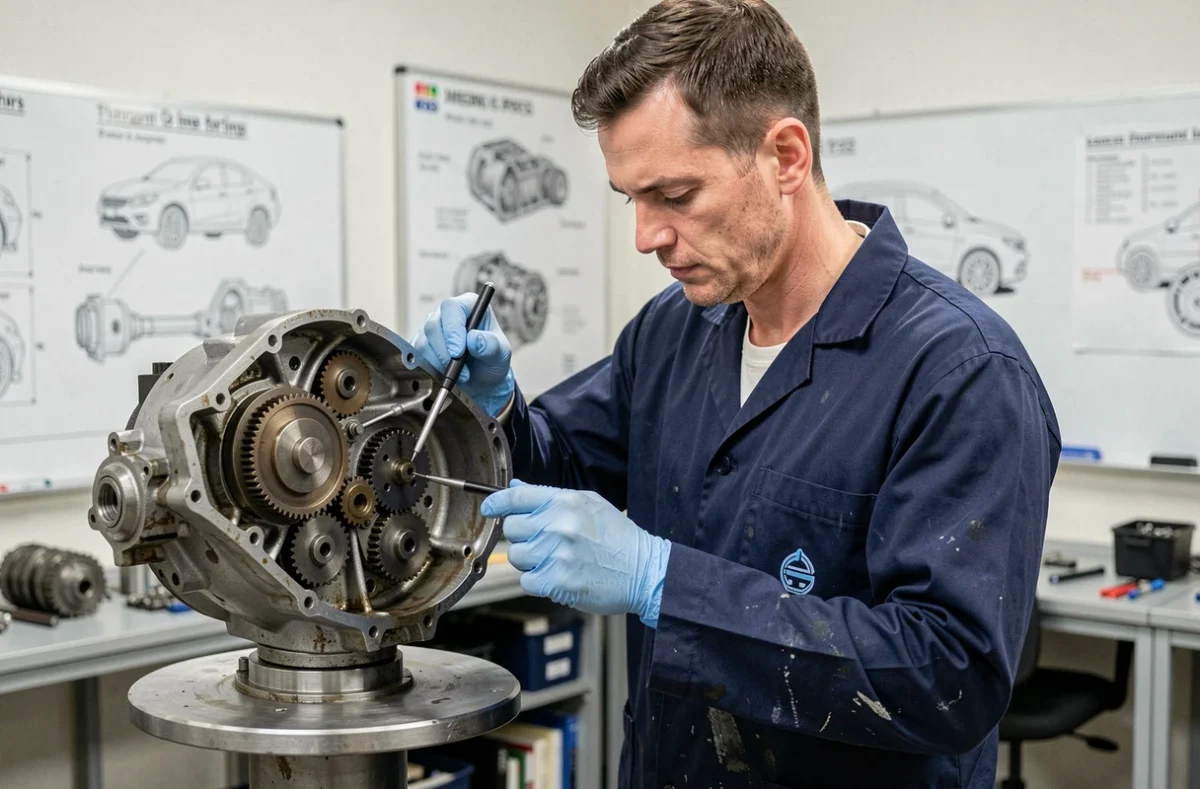
Gears, shafts, and synchronizers: the gear train of a manual gearbox
In a manual gearbox, the engine power enters through the primary shaft, connected to the flywheel via the clutch. This shaft carries fixed gears that constantly engage with the gears of the secondary shaft. The transmission ratio depends on the respective diameters of each gear pair.
Primary shaft and secondary shaft
The primary shaft rotates at the engine speed as long as the clutch is closed. The secondary shaft transmits torque to the drive wheels via the differential. Both shafts rotate in parallel, and it is the selection of a gear on the secondary shaft that determines the engaged ratio.
Each ratio corresponds to a pair of gears of different sizes. In first gear, the small gear on the primary shaft drives a large gear on the secondary shaft, which multiplies the engine torque at the expense of rotational speed. In fifth gear, the ratio reverses.
Role of synchronizers in gear shifting
The synchronizers (or synchros) equalize the rotational speed between the selected gear and the secondary shaft before the dog engages the gear. Without them, each gear change would cause a mechanical shock between parts rotating at different speeds.
- The friction cone of the synchronizer slows down or speeds up the free gear until it reaches the same speed as the shaft.
- The sliding sleeve then pushes the dog to lock the gear to the secondary shaft.
- Wear on the synchro rings explains why gear shifts become hard or noisy over time.
When forcing a shift without fully disengaging, it is the synchros that bear the overload. Their replacement is part of routine repairs on high-mileage manual gearboxes.
Clutch and differential: the linking components
The clutch and differential are not technically inside the gearbox casing, but they form the input and output interfaces of the transmission system.
The clutch consists of a disc lined with friction material, a pressure mechanism (plate and diaphragm), and the flywheel. When the driver presses the pedal, the diaphragm releases the disc, cutting the connection between the engine and the gearbox. Without a functional clutch, no gear change is possible in a manual gearbox.
The differential, located at the output of the gearbox, distributes torque between the two drive wheels. In a turn, the outer wheel travels a larger arc than the inner wheel. The differential allows this difference in speed while transmitting power. In front-wheel-drive vehicles, it is often integrated directly into the gearbox casing.
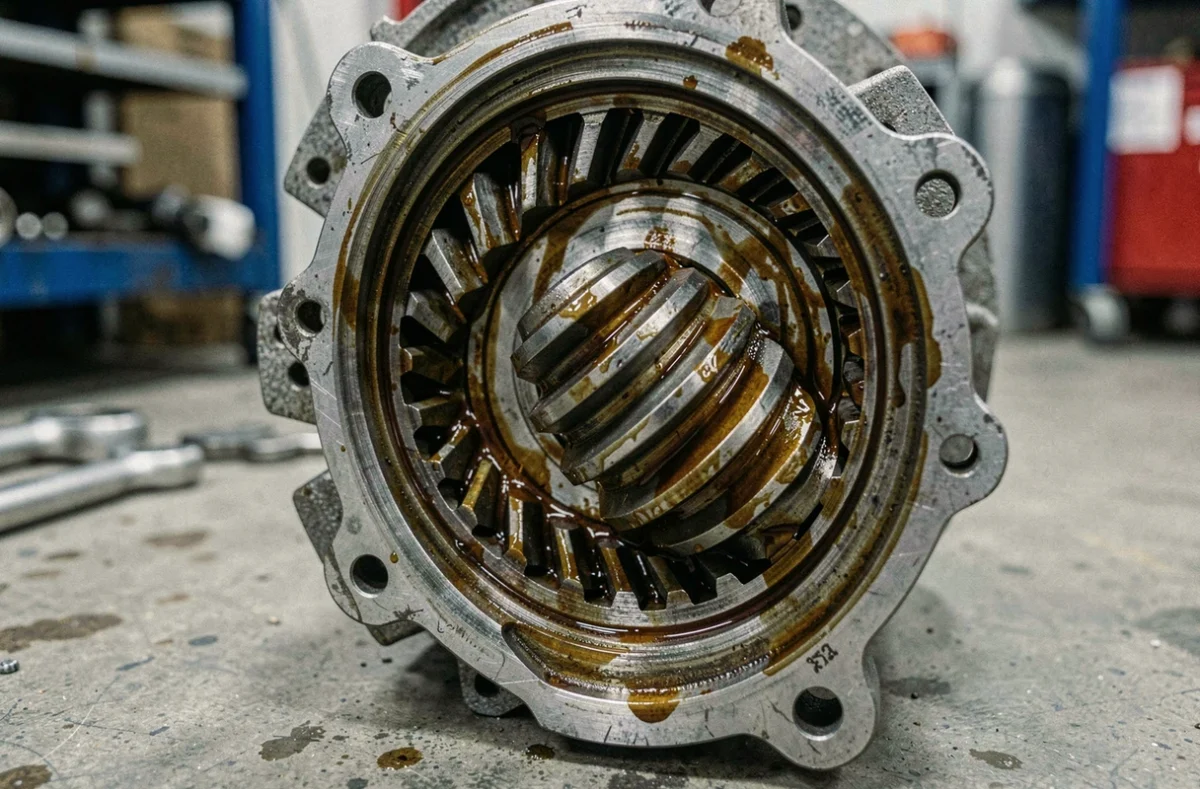
Composition of an automatic gearbox compared to a manual gearbox
A classic automatic gearbox (with torque converter) replaces the clutch with a hydraulic converter and the synchronizers with epicyclic gears. The converter uses a fluid to transmit engine torque, which eliminates the clutch pedal.
- The epicyclic gears combine planet gears, satellites, and rings to achieve different ratios without moving gears on a shaft.
- Multi-disc clutches and band brakes lock or release the elements of the gear train to select the ratio.
- The gearbox control unit analyzes the engine speed, throttle position, and vehicle speed to determine the appropriate ratio.
The automatic gearbox contains more hydraulic and electronic components than a manual one. The transmission fluid plays a much broader role: it lubricates, cools, and transmits power via the converter. An insufficient fluid level or degraded fluid causes jolts and accelerates wear on the internal clutches.
In hybrid architectures, the gearbox may also integrate one or more electric motors directly into the powertrain. The composition then depends on the hybrid architecture chosen by the manufacturer, not just the type of gearbox. Describing a modern gearbox without mentioning its control electronics would be incomplete.
Whether it is a five-speed manual gearbox or an automatic transmission controlled by a mechatronic unit, each component fulfills a specific function in the transmission chain. Identifying the faulty part, whether it is a worn synchro, a fatigued clutch, or a stuck solenoid, remains the starting point for any reliable intervention on an automotive gearbox.