
A Hermann’s tortoise that charges at feet, bites shoes, or chases a companion in the enclosure does not have a “bad temperament.” This type of behavior is observed every year in spring, sometimes as soon as they emerge from hibernation, and the typical reaction is to try to calm the animal. The reflex should be the opposite: to seek what the tortoise is expressing before intervening in what it is doing.
Diagnosing Before Calming: What an Aggressive Hermann’s Tortoise Signals
Aggressiveness in Hermann’s tortoise is not a personality trait. It is a signal, pointing in three distinct directions: reproduction, environmental stress, or pain.
The male during the breeding season is the most common case. He chases the female, bites her legs, and bumps into her shell. This sexual behavior is biologically normal, but it becomes problematic when the enclosure is too small or when the male/female ratio is unbalanced.
Before attempting anything to understand an aggressive Hermann’s tortoise, it is worthwhile to observe the precise context of each episode: at what time, towards whom (human, companion, object), and in which area of the enclosure.
A tortoise that consistently bites during feeding does not send the same signal as a tortoise that charges at a bare foot in the garden in May. The former may express food frustration or oral pain. The latter is likely confusing your toes with a threat or a potential mate.
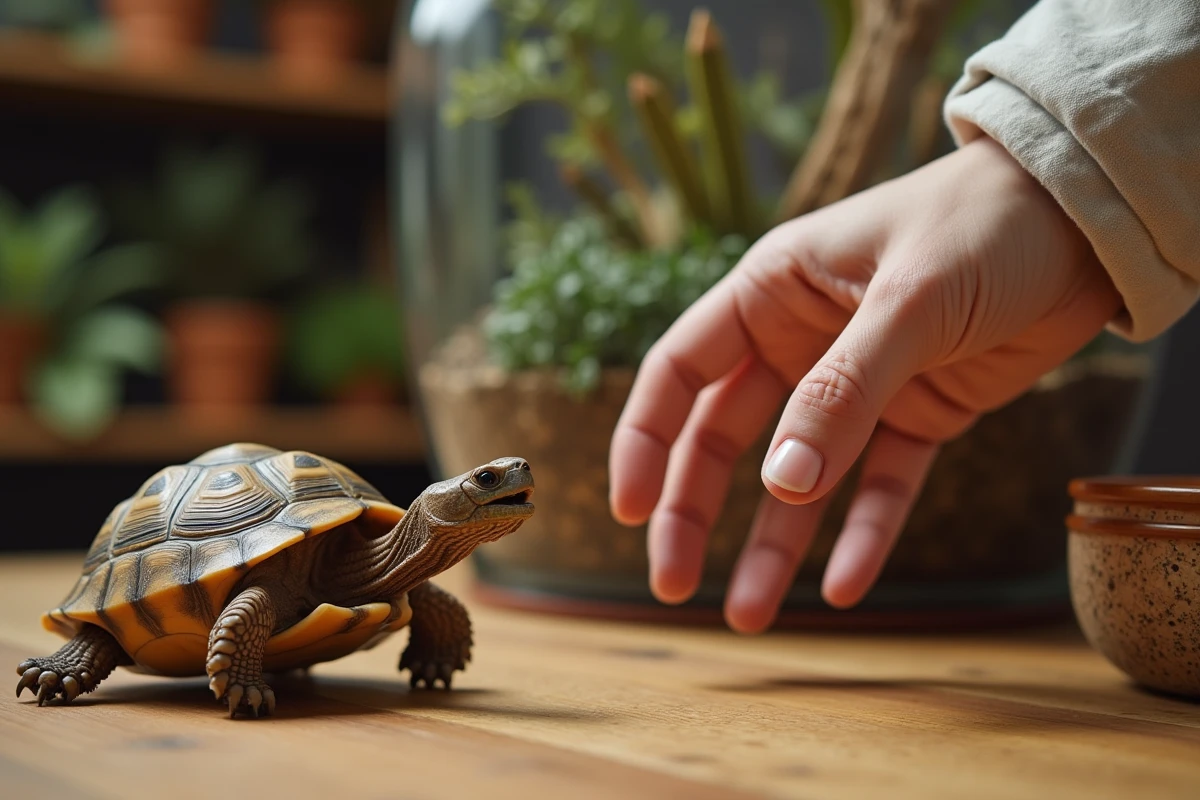
Male Hermann’s Sexual Behavior: Normal Aggressiveness or Inadequate Enclosure
In Hermann’s tortoise, the most documented aggressiveness concerns the male during mating season. Chasing, biting, and shell bumping are part of the species’ reproductive repertoire. This behavior cannot be eliminated, only its consequences can be limited.
Male/Female Ratio and Enclosure Size
A single male with one female in a confined space will relentlessly harass that female. Providing at least two to three females per male helps distribute the pressure. If only a pair is available, temporary physical separation during peaks of sexual activity remains the most straightforward solution.
The size of the enclosure plays an underestimated role. A terrestrial tortoise that does not have enough space to flee or hide experiences constant stress. Retreat areas (low bushes, elevated flat stones, recesses) provide the female with visual shelters that interrupt the male’s pursuit.
Recognizing a Male in Rut
The male during the breeding season nods his head rapidly, sometimes emits high-pitched sounds during mating, and becomes noticeably more mobile. These signs appear mainly in spring, after hibernation, when temperatures rise. Reports vary on the exact duration of these episodes, but there is generally a gradual decrease as summer progresses.
Enclosure Stress and Pain: Overlooked Causes of Aggressiveness
When a Hermann’s tortoise becomes aggressive outside of any breeding period, or when a female exhibits this type of behavior, it is necessary to explore other avenues.
Environmental Stress
A poorly designed enclosure generates chronic agitation that is mistaken for aggressiveness. Here are the most common stress factors:
- A space that is too small where the tortoise constantly bumps against the walls, leading to attempts to climb and charging behaviors
- The absence of shaded areas or hiding spots, preventing the animal from regulating its temperature and escaping stimuli
- An unsuitable substrate (concrete, coarse gravel) that irritates the plastron and legs, making every movement uncomfortable
- Forced cohabitation with a cat or dog in the garden, whose regular presence near the enclosure keeps the tortoise in a constant state of alert
Stable routines (regular feeding times, minimal handling) gradually reduce agitation. Habituation works better than confrontation to calm a stressed tortoise.
The Pain Factor
A tortoise that suddenly bites when it did not before may be in pain. Respiratory infections, oral abscesses, egg retention in females, or shell injuries cause clear behavioral changes.
An animal that refuses food and becomes aggressive to touch should be examined by a veterinarian specialized in reptiles. This is not a character issue to be managed with enclosure adjustments.

Concrete Solutions to Reduce Aggressiveness in a Hermann’s Tortoise
Once the cause is identified, the interventions are fairly simple to implement. They vary depending on whether addressing a reproductive behavior, enclosure stress, or a medical issue.
For the Male During Breeding Season
- Temporarily separate the male using a partition in the enclosure or a second dedicated space during peak hormonal weeks
- Add visual barriers (stones, dense plants) that break lines of sight and interrupt chases
- Never punish or spray water on a tortoise that charges; this produces no learning and adds stress
For Environmental Stress
Revising the layout of the enclosure is the fundamental response. This means providing a sufficient outdoor space with loose substrate, low vegetation, shallow water points, and retreat areas. Adopting a Hermann’s tortoise commits you to providing an enclosure that replicates its natural living conditions, not just a simple fenced garden square.
For Pain
No adjustment can replace a veterinary consultation. If aggressiveness appears suddenly in an otherwise calm animal, this is the first reflex to have.
The Hermann’s tortoise lives for several decades. Its behavior evolves with age, seasons, changes in enclosure, and the presence of other animals in the garden. An aggressive tortoise at six years old may not be so at twenty, provided that the cause has been addressed rather than just the symptom.