
When preparing a curry, a velouté, or a Thai sauce, and the can of coconut milk is empty, the reflex might be to grab any plant-based milk from the cupboard, but the result is likely to be watery or bland. Replacing coconut milk in a savory recipe requires understanding what it truly brings to the dish: fat, creaminess, and a roundness on the palate that most substitutes do not replicate on their own.
The Role of Fat and Emulsion in Your Savory Coconut Milk Recipes
Coconut milk is not just a flavored liquid. It acts as a natural emulsifier that binds spices, herbs, and cooking juices into a homogeneous sauce. Its fat content gives it a coating power that standard plant-based drinks cannot achieve.
When almond milk or rice milk is poured into a curry instead of coconut milk, the sauce lacks body and breaks down during cooking. The fat in coconut milk also carries the fat-soluble aromas of spices (turmeric, galangal, lemongrass), which explains why a dish made with a substitute that is too light seems less fragrant, even with the same ingredients.
Before choosing a substitute, one should ask the right question: does coconut milk serve as a liquid base (soup, broth) or as a creamy binder (sauce, finishing)? The answer changes everything. As advised by Journal Global, adapting the substitute to the specific role of coconut milk in the recipe avoids unpleasant surprises.
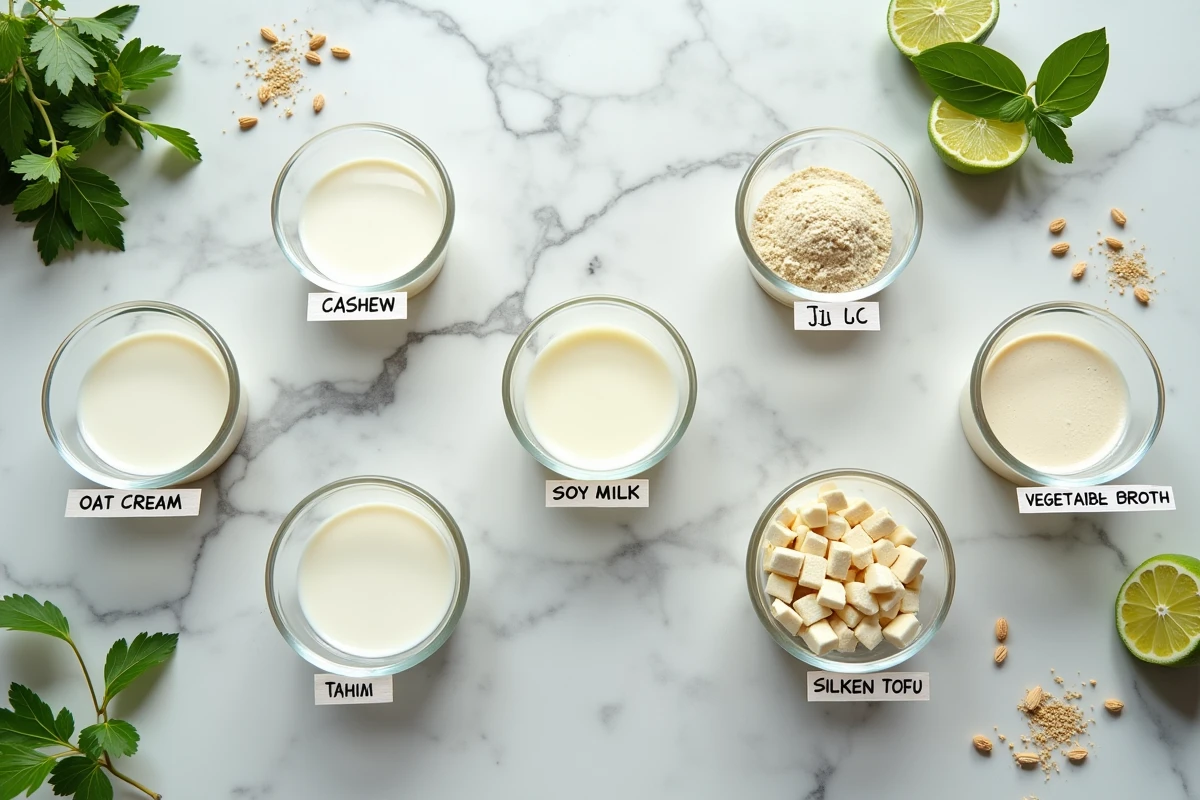
Cashew Cream and Soy Cream: Two Savory Substitutes That Hold Up to Cooking
Among all the alternatives tested in savory cooking, two stand out for their ability to withstand heat without curdling or losing their texture.
Homemade Cashew Cream
Soak raw cashews for a few hours, then blend them with a bit of water until you achieve a thick cream. Cashew cream provides stable fat and a neutral flavor that does not mask the spices. It naturally thickens the sauce without the addition of starch.
In red curry or korma, it replaces coconut milk almost in equal volume. For soups, it can be thinned with vegetable broth to achieve a more fluid consistency.
Culinary Soy Cream
The “culinary” version sold in cartons is thicker than regular soy milk. Its neutral flavor makes it a reliable base for bold sauces. It holds up well to long cooking times (stews, casseroles) without forming lumps.
Feedback varies on this point: some find that soy cream leaves a slight bitterness in very spicy preparations. This can be corrected by adding a pinch of sugar or a splash of lime juice at the end of cooking.
Fermented Dairy Products: An Underestimated Option for Savory Sauces
Online competitors almost all focus on plant-based milks. In non-vegan savory cooking, fermented dairy products often yield superior results, especially for sauces and stews.
- Greek yogurt provides a controlled acidity that structures the sauce and replaces the creaminess of coconut milk. It should be incorporated off the heat or at very low heat to prevent curdling.
- Thick sour cream works as a direct fatty binder. It holds up better during cooking than yogurt and gives a result close to the texture of coconut milk in a velouté or tikka sauce.
- Thick cottage cheese can replace coconut milk as a finishing touch, added at the last moment to create a roundness on the palate without weighing it down.
The advantage of these options: they stabilize emulsions thanks to their proteins, where a light plant milk tends to separate from the fat of the spices.

Adapting the Substitute According to the Type of Savory Dish
A Thai curry, an Indian dhal, and a butternut squash velouté have different requirements. Here are the combinations that work best in practice.
- For a spicy curry or stew, cashew cream or culinary soy cream replace coconut milk without altering the aromatic balance. The substitute should be added midway through cooking so that it integrates with the spices.
- For a velouté or soup, oat milk (barista version, thicker) offers a sufficiently dense texture. Its slight cereal flavor fades behind roasted vegetables or herbs.
- For a finishing sauce (drizzled over fish or grilled vegetables), Greek yogurt or sour cream provides immediate creaminess without additional cooking.
- For a dish where the coconut flavor is central (like tom kha soup), no substitute faithfully replicates that flavor. One can add a teaspoon of virgin coconut oil to the chosen substitute to regain some of the aroma, but the result will still be different.
The Dilution Trap
Many online recipes recommend replacing coconut milk “in equal volume” with any plant-based milk. In reality, a standard plant milk contains much less fat than coconut milk. If the same amount of rice milk is poured into a curry, you end up with a watery sauce.
The practical rule: reduce the amount of substitute by about a quarter compared to the volume of coconut milk indicated, then adjust the consistency at the end of cooking with broth if necessary.
The choice of the right substitute for coconut milk in a savory recipe depends less on the ingredient itself than on the role it plays in the dish. Cashew cream in a curry, Greek yogurt in a tikka sauce, soy cream in a stew: each combination meets a specific technical need.
Keeping a spoonful of coconut oil on hand remains the last resort to regain a hint of that tropical flavor that nothing else truly replaces.