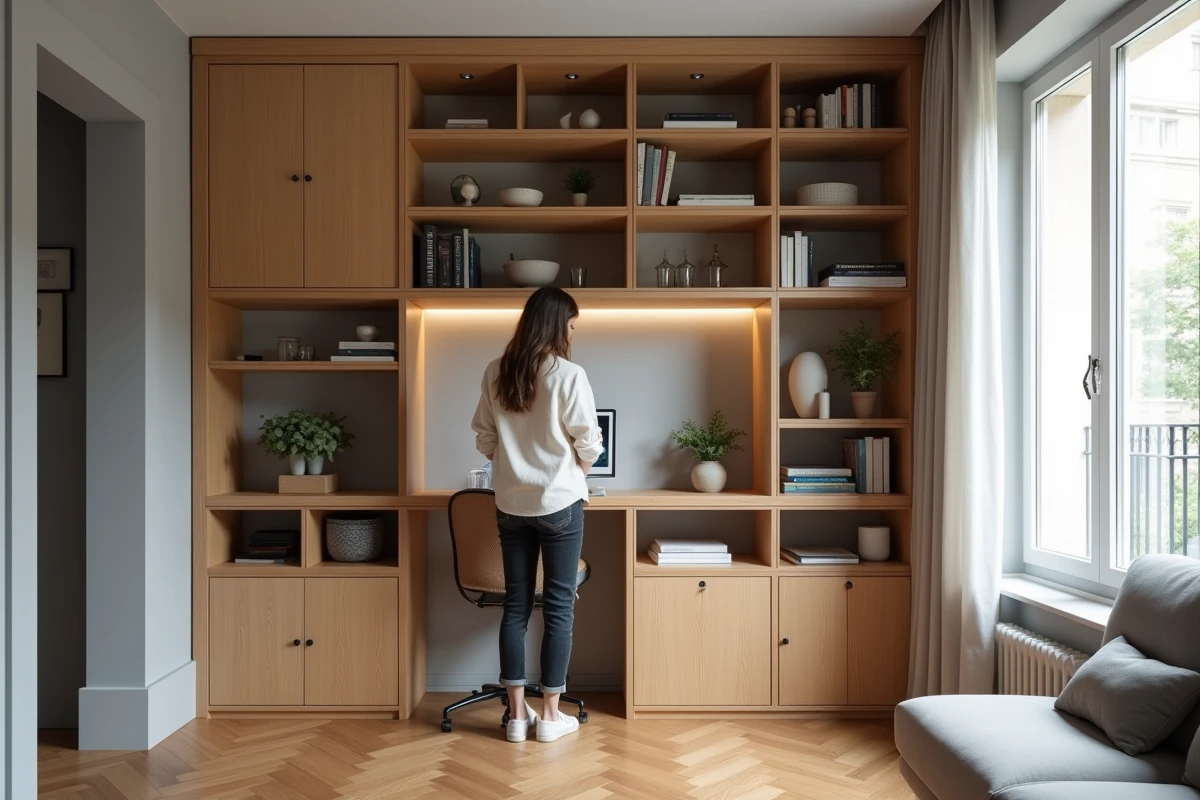
A sloped closet that doesn’t close, a 40 cm niche between two load-bearing walls, a corridor too narrow for a standard piece of furniture: it’s often from these very concrete constraints that the question of custom furniture arises in a small space. The common reflex is to look for a flat-pack piece with the right dimensions. When no model fits, we move on to custom-made, sometimes without having measured all the implications, especially in rentals.
Custom furniture in rentals: balancing cost, modularity, and reversibility
In a property we own, fixing a wall-mounted bookshelf from floor to ceiling is not a problem. In a rental, the situation changes radically. We commit a budget to a layout that we may not be able to take with us, or that won’t suit the next apartment.
The balance is struck on three criteria. First, cost: a custom piece fixed to the wall is significantly more expensive than a freestanding module, and both installation and removal add to the bill. Next, modularity: a layout designed for a 1.20 m niche won’t fit anywhere else.
Finally, reversibility: a tenant must return the property to its original state, which excludes heavy drilling or partition modifications without the landlord’s agreement.
We can consider the installation of custom furniture with Au Top by prioritizing removable systems, fixed by pressure between floor and ceiling or placed on reversible tracks. These solutions allow for the entire setup to be recovered during a move without leaving traces.
Custom storage for sloped ceilings and dead corners
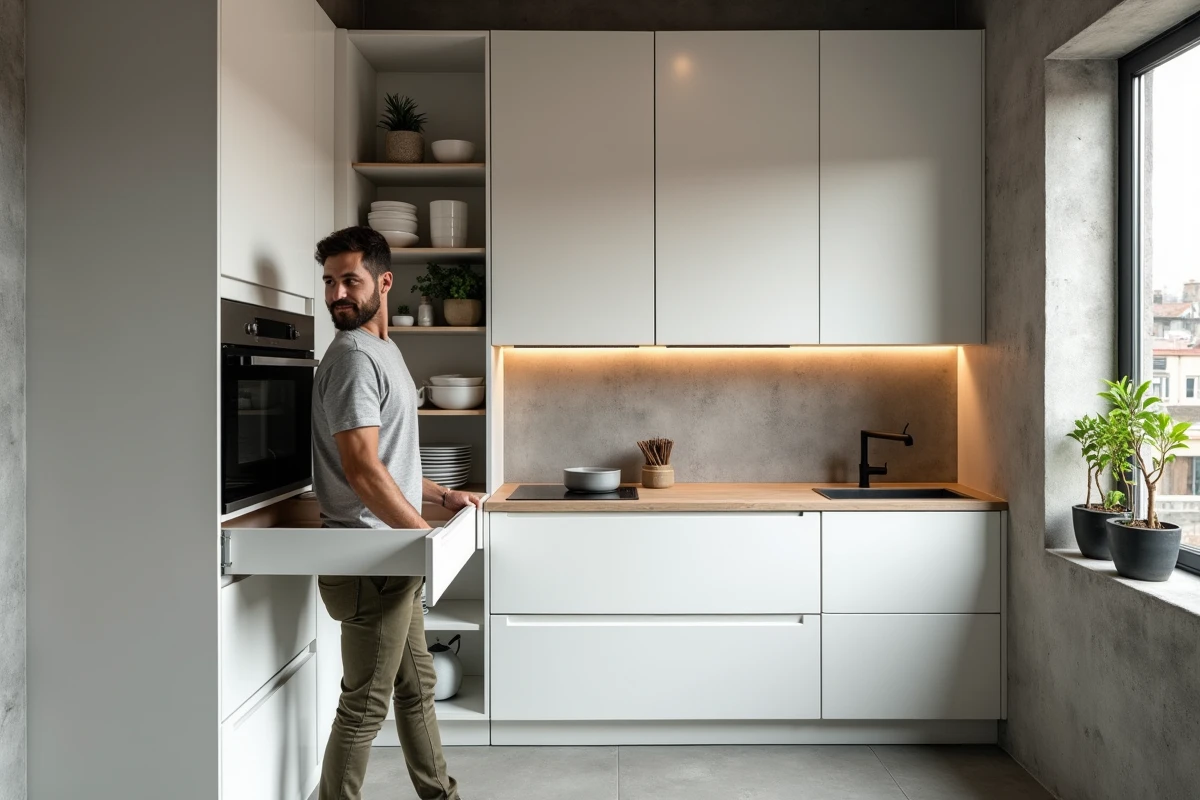
Competitors talk a lot about storage in general. In practice, the real gain of custom solutions is measured in areas that standard furniture ignores: sloped ceilings, obtuse angles, narrow recesses between a wall and a column.
A box adjusted to a sloped ceiling utilizes all available depth, where a rectangular wardrobe leaves a void triangle behind it. For these configurations, we work with handle-less fronts (push-to-open) that do not add any protrusion in an already constrained passage.
Niches and residual spaces
A niche less than 50 cm wide between two load-bearing walls seems useless. However, we can integrate shelves all the way up, with removable shelves to adapt to the contents. The same principle works above a door or in the space between the top of an existing closet and the ceiling.
Custom solutions also correct a common problem in older buildings: walls that are not square. A standard piece leaves a visible gap on one side. A panel cut to the exact angle of the wall eliminates this flaw, and the result appears integrated into the architecture.
Verticality and integrated furniture: gaining square meters on the wall
In a small space, the floor is the rarest resource. Every piece of furniture placed on the floor reduces circulation. The most effective strategy is to exploit verticality up to the ceiling rather than dispersing low storage.
In practical terms, this involves several devices:
- High custom columns (kitchen, entry, bathroom) that reach the ceiling and incorporate compartments accessible at the bottom and long-term storage at the top.
- Suspended modules fixed to the wall, which free up the floor below for passage or a second use (bench, shoe storage).
- Open wall shelves in metal or wood, less deep than a classic piece, sufficient for books, dishes, or everyday items without encroaching on the room.
Opinions vary on the use of very high storage: some find them impractical for daily use. In reality, the upper part is mainly used for seasonal storage (duvets, suitcases, archives) and does not need to be accessible every day.
Headboards and benches: invisible furniture
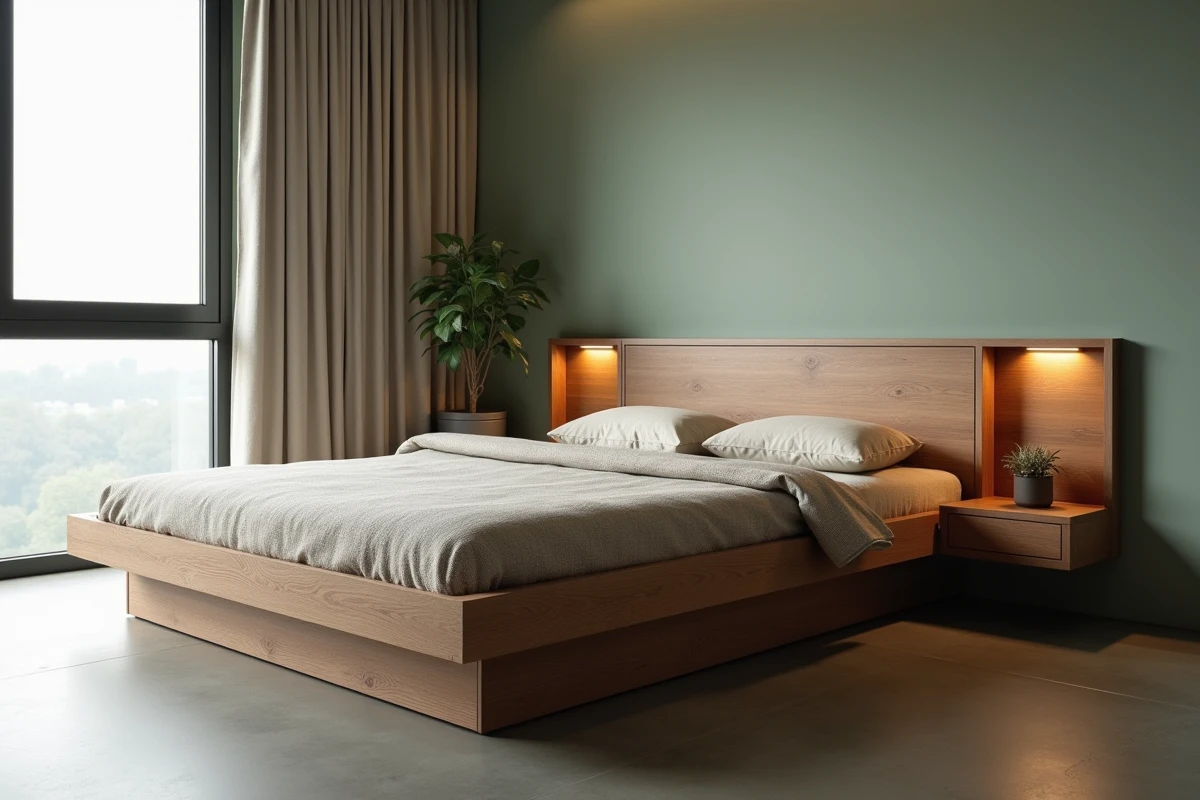
A headboard with hidden storage replaces a bedside table without taking up additional floor space. It can hold books, charging cables, glasses. The storage bench serves the same role in an entryway or living room: a seat that absorbs clutter instead of exposing it.
These integrated pieces work even better when they are designed from the start with fronts aligned to the walls. The visual effect is that of a larger room, because the eye does not stumble upon any protruding volumes.
Folding tables and sliding doors: freeing up passage daily
In a studio or a compact two-room apartment, the dining table poses a recurring problem. It takes up space permanently while being used only two or three times a day.
A wall-mounted folding table folds away in seconds and frees up a complete circulation space. The same principle applies to wall-mounted desks, which offer a temporary work surface without requiring a permanent desk.
Sliding doors (or pocket doors, when the partition allows) eliminate the swing of a classic door. In a narrow hallway or between a kitchen and a living room, we recover the area swept by the door leaf, often more than half a square meter.
- Wall-mounted folding table: ideal in kitchens or entries, folds flat against the wall.
- Surface-mounted sliding door: does not require heavy work, compatible with rentals if the fixing remains reversible.
- Wall-mounted desk: foldable work surface that disappears once closed, suitable for occasional telecommuting.
On these elements, the boundary between custom and ready-to-assemble blurs. Several manufacturers offer kits for wall tables or adjustable sliding tracks, allowing for budget limitations while adapting dimensions to one’s space.
Custom furniture in a small space does not need to be permanent or expensive to be effective. Prioritizing removable and vertical solutions allows for maximizing every square meter without locking oneself into a fixed layout, whether renting or about to sell.